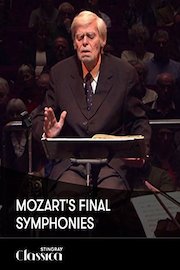
Mozart's Final Symphonies is a mesmerizing and captivating movie filled with music that instantly transports the viewers to a world that is rich in classical music. It is a production that richly deserves the title of a masterpiece as it provides a captivating insight into Mozart's final symphonies. The movie is performed by the Orchestra of the 18th Century, and it is a breathtaking tribute to one of classical music's greatest composers. Led by the Dutch conductor Frans Bruggen, the Orchestra of the 18th Century showcases their exceptional talent in this movie, and the viewers are in for an unforgettable musical treat.
With the Orchestra's exquisite musicianship and Bruggen's encyclopedic knowledge of classical music, Mozart's Final Symphonies delivers a perfect blend of entertainment and education. The production glides seamlessly from one piece to another, effortlessly melding Mozart's final three symphonies into a triptych of musical beauty that takes the viewer on a journey beyond compare.
The Orchestra of the 18th Century, renowned for its period-inspired performances, provides an unforgettable auditory experience. With their use of historically accurate instruments, performance practices, and aesthetic sensibilities, they transport the viewer back to Mozart's time, giving an authentic feel to the music.
The movie opens with Mozart's Symphony No. 39, a piece that exudes majesty and grandeur in every note. The Orchestra delivers a masterful rendition of the piece, and the audience is captivated by its sheer power and depth. Such is the Orchestra's proficiency that the music sweeps the viewers into a world of beauty and wonder, and they come out feeling rejuvenated.
Mozart's Symphony No. 40 follows, and it is a piece that is highly regarded for its emotional complexity and moodiness. The Orchestra performs it with such dexterity that the audience is encapsulated by its somber elegance. The melancholic themes of the piece are brought to life with the Orchestra's expert touch, creating an unforgettable musical experience.
The final symphony, Symphony No. 41, also known as the Jupiter Symphony, is the centerpiece of the movie. This symphony is known for its harmonic complexity and grandeur, and the Orchestra of the 18th Century does not disappoint in their performance of it. The viewers are taken on an aural journey of stunning complexity and boundless beauty. The music sweeps the viewers off their feet and takes them on an excursion of pure musical euphoria.
The movie's presentation is a feast for the eyes and ears. The Orchestra of the 18th Century performs on period instruments, and the mise-en-scene is set in such a way as to make the viewers feel like they are seeing a performance from Mozart's era. The costumes, stage design, and lighting all work in concert to create an immersive experience that is truly breathtaking.
The movie is a testament to the enduring legacy of Mozart's work, and it is a production that is sure to be enjoyed by all classical music enthusiasts. The Orchestra of the 18th Century's performance is extraordinary, and their passion for the music shines through in every note. Through this movie, the viewers can experience Mozart's masterful composition firsthand, and they come away with a deeper appreciation of his genius.
In conclusion, Mozart's Final Symphonies is an exceptional movie that elegantly captures the essence of Mozart's final three symphonies. The Orchestra of the 18th Century is in top form, delivering a performance that is truly mesmerizing. The movie is a true masterpiece that is sure to be enjoyed by classical music enthusiasts of all ages.